I have been trying to find motivation for this update, so if you only care about the book, then let’s get that out of the way. I got 12 pages of notes to implement ranging from “Add a dog to the sheep scene” to “Research mining related riots in 1929 Scotland“, and the book has remained at 65.000 words.
This is overshadowed by the news that I got made redundant. Not fired without pay, so not the worst way to lose your job, but not ideal at Christmas. This happened a little over two weeks ago and it definitely took the wind out of my sails.
Six years on and the recruitment business is having the financial sniffles, and the only way to survive is to burn out the fever, taking some talent with it. So I guess this is as good a time as any to reassess and reorient, get some rest in and fix the odd bit around the house.
The question that naturally arises is what to do next?
As a child I only had a few things I wanted to be: helicopter pilot, secret agent, and an author. Helicopter pilot was never going to happen due to bad eyesight. Secret agent was the work of silly movies with silly plots and, most importantly, is nothing like real espionage. Which leaves authorship the only viable dream.
My ongoing love affair with books started young for me. I spent more time at the library than in my room as a teenager, and to this day I remember where my favorite sections were at my local library. I remember rows of index cards showing where the good stuff was (Ninjutsu*, Greek myths and African Fauna comes to mind), and exploring shelves for hours just in case I missed something good (which I did. I didn’t read The Lord of the Rings until I was in my early twenties).
As I grew older, the idea of writing a book was something you had to do. In my head, anyone and everyone needed to write a book about something, anything, and add it to humanity’s corpus of knowledge. It’s silly, simple even, but it’s what I expected others would do and I would do the same. The great thinkers of our time had done so, why wouldn’t others try it as well?
Interest in writing and whether you had something to say, didn’t really factor into my logic at the time. Nor did the idea of publishing, building a plot, understanding sentence structure, format, intent or anything else. You just had to contribute. It was the most natural idea in the world, and while over the years I learned that very few people actually think the same way, the realization didn’t temper my drive.
This is the main reason I write. I may never get published and that’s fine, but I set myself the goal of finishing my book in 2026 and this unintentional career break will be a much needed space to get it done.
As this is the last post of 2025, I wish you all a joyful 2026. Happy New Year!
TL;DR – Book is going well, lost my job and I am looking forward to writing more.
Autocorrect does not like the word Ninjutsu word. While writing it suggested Ninjitsu, Jujitsu and Injurious as correct terms. Never trust your AI tools.
The book has now passed 65.000 words, despite culling over 8.000 words worth of fluff, guff and unnecessary shenanigans. Unfortunately, I won’t be able to work much on it over the next month or two as we are in the middle of moving, and the new place is in need of a loving hand and the occasional use of a sledgehammer. Very exciting.
Hope to have an update around Christmas when things are less chaotic and I can resume work.
That said, I just came back from a research trip in Edinburgh. If I had known a research trip would be that fruitful, I would have made up an excuse to go much sooner. There were a few objectives, but the most important was to visit key locations from the book in and around Edinburgh and get a feel for their physical context, and how their geography would affect the narrative.
Now, I’ve been to Edinburgh before (and I quite recommend it) but those excursions were for other, alcohol fueled, reasons. On this trip I got to examine the city from the viewpoint of someone building a narrative and it changes how you experience the city. It ceases to be a series of individual buildings or sites, and becomes a massive group of interconnected systems; roads and sewer connections inform how the city operates, smells and functions, parks become scenes instead of just scenery, and institutions become places of power and influence. Your characters start roaming the streets and the streets influence what they can do, both limiting in scope and expanding in opportunity.
The trip was simultaneously disheartening and invigorating. Disheartening that the real life locations for some scenes are simply not suitable, and invigorating that I could find alternatives sometimes just a few hundred meters down the road.
For example, I initially wanted to place a fictional bookshop at Arthur Conan Doyle’s place of birth, here if you are interested. What I envisioned was a lone edifice holding out against the encroaching dark, both literally and metaphorically, but after reviewing maps from the time period and visiting the location it became evident that it didn’t work. Feeling dejected, my wife and I wandered the neighborhood looking for an alternative, and while searching for a caffeinated beverage, found it. Just around the corner were several smaller, Georgian style buildings that would fit the imagined book shop, including smaller cobbled passageways for those illicit activities or escape routes.
It may sound silly, but grounding the story in a real location with real limitations feels like the correct approach. And this is just one example of many. We wandered about the old buildings of Edinburgh University, toured cathedrals and went strolling around the park near Blackford Hill. The Scottish Mining Museum was also a great experience.
Geography is especially important to me. It’s a pet peeve of mine when liberties are taken with facts. If locals can call out on something because it didn’t exist as portrayed, such as a location or a distance central to the story, the book isn’t accurate enough. Unless explicitly excused (read: alternate timeline, genius inventor or similar), I simply prefer it to reflect reality.
Personally I enjoy writing around limitations, it tends to improve the reading experience. This extends to technology, use of historical characters, and so on. Taking liberties is fine, in context, but personally I try to stick to reality as much as possible. It grounds what could otherwise become a flight of fancy.
And interestingly, it turns out some of my choices in geography were dead on, so kudos to me, and the very lovely people at the Scottish Mining Museum and Edinburgh University who dedicated their free time, hospitality and were patient and helpful with my very specific queries.
Anyway, I wanted to get this post out before I shatter my spine carrying moving boxes. Here are a few tips I have been thinking about recently to help you tighten up your own writing.
Weasel words – “Maybe we could do something new.”
Anyone with an academic background probably had a conversation about weasel words. These are words that dilute your argument or commitment and that reduces the value of what you’re saying. Unless your aim is to dilute your statement or create a feeling of indecision, consider purging it from your writing. Make it something you consciously choose to use.
Filter words – “Jerry sensed (or thought or understood or spotted) the weather changing.”
Or maybe the weather changed. Similarly to ‘Weasel’ words, ‘Filter’ words are used to mediate or interpret a situation through the character, instead of giving the reader a visceral impression. Its the difference between seeing a recording, or witnessing it in-person.
As I am finishing this post, the word count is just shy of 53.000, which I am quite happy with. My initial goal for the book was at least 50.000 words, but that was by no means the end point. Especially not now that the scope has expanded, which is what I wanted to write about today.
First off, I would encourage any would-be writer to path out your narrative ahead of time. I spent a few hours plotting out my characters and created an Excel sheet to see just how good (or bad) my outline is. As it turns out, it was too simple. Or rather, there was a story and an arc for the main character, but there was little mystery, background and worldbuilding, only ideas here and there.
So I took a break from writing and listened to a few books for inspiration, specifically Rivers of London and Moon over Soho by Ben Aaronovitch (delightful reads and exceptionally well narrated by Kobna Holdbrook-Smith). I could gush over them for hours and I just might at some point, in audio <— Foreshadowing.
Like many others have said: the best way to become a better writer is to write. What helps immensely though is reading extensively as well. I love the writing and the performance of Rivers of London, so I wrote down, and tried to codify what is was that made the story come alive to me. None of the following realizations are revolutionary, but they pushed me forward and expanded the scope of my own project, so maybe it can help you.
The Need to Paint the scene… in a physical sense and, more importantly, what it feels like to be there. If you read the book, Peter (the main character) comments on everything around him through dialog with others and his own internal narration. He comments on the little things, what does or doesn’t remind him of home, how the lives of others changes how he views a scene? Whether something is a tired old hat, or new, or dangerous, or just background noise adds layers that texture the scene.
You get a closer, more intimate narrative that adds subtle texture to a story. It’s the difference between knowing there is a Circle line on the London Tube and telling the reader or explaining what it feels like to be sat boiling in the July heat en route from Paddington to Edgware Road Station. One is factual, the other experiential.
There is a part in Rivers of London where magic, something wildly exotic, is observed by the main character with near boredom. Taking you, the reader, into the mind of Peter and showing how he sees the world and his progression as a character, without over-explaining it through the events.
Reflecting on What Happened – The reader of a book has the privilege of consuming a series of curated events and experiences that tie together and create the plot. The characters in the book don’t know that, so you need to show how the character reflects on what is happening. In the moment, ten pages later, a hundred pages later, the way characters visit and revisits events showcases how they perceive the evolution of their own story and understand their place in it. Or in many cases, don’t understand it. Not the chain of events, but the causal links in a chain and how they interconnect.
If the character doesn’t understand where they come from and how they got to a certain place, the reader won’t be invested either. Exploring their hopefully growing understanding of what is happening in the story or lack thereof, the reader gets to understand them better.
Personally, I have a problem with rooting for two-dimensional characters that have no understanding, lack motivation or a goal. We need to see them engage with the plot, not adrift in it.
Having Opinionated Characters – Opinions are like assholes, everyone has them. So have characters that share their opinions to showcase how those opinions change over time. The experience of an event, banal or fantastic, good or bad, seen by someone in situ again adds more texture, more micro narrative to your story.
These can be small details like the taste of a cocktail, a preference for jazz music, or someone’s perceived reputation (truthful or not) or larger events, like the death of a character, the swing of public opinion or breaking a taboo; the latter is especially interesting when you have characters that are strongly invested in upholding that taboo.
Cross-cultural understanding is interesting, but cross cultural conflict between characters, factions, neighbors, parents, dogs, cats, whatever you have is so much more engaging.
I find that Aaronovitch is fantastic at weaving in the feel of a culture, how the characters understand their place in it and how they represent it through their built-in biases, ideas, hopes and dreams, by getting the cast to externalize what they see things, what they do and don’t know.
These initial takeaways helped to expand the scope of my book, hopefully in good way.
However, I have a problem managing scope. This is a common issue for me and as this is project will eventually need to end. It’s an issue if I keep adding ideas that pop into my head. I refer to it as Concept Creep and it has become the one thing I am desperately trying to curb before it overwhelms me.
Back when I wrote my theses, my first meeting with a lecturer on what the scope of the piece would be, the lecturer bemusedly informed me that what I thought was a decent, well defined, idea would take at least a Phd level project to explore fully. Two would be better. So this is nothing new.
For that reason, if you have similar issues with your writing, get your basics done first. Figure out the plot, subplots, the main themes, events and characters. If you have a lot of lore, keep a lore bible. It can be a notebook, some digital log or worldbuilding app. Once you have the basics figured out, you can focus on texturing the piece. Smaller backstories that get peppered in to flesh out characters, a comment here, a plot device there that pays off in the finale. And don’t be afraid to cut out segments that aren’t working.
My first 17.000 word draft included a very complex backstory and specific events for a character that wasn’t needed. For now, that piece is relegated to the lore bible, but once the book is finished it might get pulled back in, or even reused in another work. We will see.
TL:DR – If you are stuck in your own writing, go read something, take notes, compare it to your own writing and see if you can take inspiration from it.
You only need to break two metacarpals to get wildly sidetracked from writing and other creative pursuits which is why I haven’t updated the website in a while. That and I am in the process of buying a house, which is going well, but all in all it has taken away time and energy. But mostly its the hand.
And while in the grand scheme of things its not a major injury, it has been debilitating. The short version of what happened; it turns out security doors are harder that my bones. Especially if one slams on your hand when you aren’t looking. I was not amused.
Please enjoy this x-ray and the associated distress.
What has this experience taught me?
Life will happen, accidents will happen, and you will have to adapt.
For work and for my personal writing I had to change, amend, or outright write off deadlines and goals that were unattainable. This sucked the motivation right out. I had finally established a strong writing routine, consistently producing around 500+ words daily, and over night it was gone. So I adapted and found new tools to help me.
It is inevitable, that something like it will happen to you, so take it as an opportunity to reorient yourself and try different ways of doing things. For me, I settled into a routine of reviewing, revising and working on the world building for the novel. That latter one is just reading a lot. I recommend it.
The other thing I discovered that allowed me to continue working professionally and on my writing was the speech-to-text option in Windows 11. It is an accessibility that allows you to dictate directly through your device microphone and the tool will transcribe it word for word.
Use the Window key + H to access the tool. Read more here.
My personal use case is for email and light writing, but like most things its not perfect.
Its awkward to use
To be clear, this is not like using Alexa or Siri. You are essentially talking to yourself and there is no fancy filter to fix your mishaps. In the beginning it will feel weird. You will mumble, stutter, say the wrong word, etc. but once you get used to it, it will be fine.
Consider what you want to write first, then speak slowly and clearly, enunciating every word fully. Don’t be alarmed if what is appearing on the screen is incorrect. Finish it first, then fix any mistakes.
You need editing
While impressive, its not perfect. If you’re not a native speaker, or have a tendency to mumble, or even speak too fast, it will have trouble recognizing what you say. Grammar is also finicky, but you can disable automatic-punctuation depending on your preference.
Just get the basics down and edit it.
It wont work public
Ignoring the social aspects of speaking to yourself in public, the tool doesn’t work well in noisy environments. As of writing this, its not capable of separating out your voice pattern from others.
At work I had the pleasure of accidentally transcribing most of what my colleagues said, which was hilarious to read, but made it unusable.
And lastly, a quick aside on the novel.
As of right now, I am back to my writing schedule, which remains the same 250 new words every day until the first draft is done. Right now, the novel has hit 47.700 words, which is about 2/3 of the way towards my end goal. I hope to have the first draft finished by the end of summer, so stay tuned if you want to keep up.
Been a while since my last post due to regular day to day work, and having to rethink and rework my book premise. As of today I have around 15.000 words on my current draft, with some parts of a previous draft worked in, so it wasn’t wasted.
So, why restart a project? Now there can be many reasons and most of them end up being excuses not to work on hard bits of your book, be that structure, a dead end you wrote yourself into or just that its more fun to start something than finishing something. My shelf of in-progress miniatures are a testament to how bad I am at that personally.
In my case it was due to the sprawling narrative of the story taking place. My central trio of characters are traveling from Edinburgh to Cairo to complete a task, but the story I wanted to write was a personal one. One of men dealing with trauma, substance abuse and purpose, set to a backdrop of 1920s Scotland. The story didn’t need an epic backdrop to work, so I pivoted and made it smaller in scope and more personal, so the backdrop does not distract from the topic.
It is a similar problem that stories about Spider-Man or Batman face. These heroes are personal in nature, dealing with problems or challenges inherent to their identity and history.
When your friendly neighborhood Spider-Man is removed from stopping purse snatchers and foiling bank heists, to to be faced with world ending threats, he is not as interesting anymore. Fun, for sure, but the reason we love the character is because of the smaller problems he has, like dealing with girlfriends, and balancing school + work with being a hero.
Same for me with Batman. His psychological issues and damn near suicidal need to fight every lowlife in Gotham is more interesting and asks more foundational questions, than if he is tasked with extraterrestrial threats.
It is always the smaller personal conflicts that spark interest. If everything has to be as big and grandiose as possible, we miss out on much better intricate stories and moments. I often consider if some of the projects I have, that are on permanent hiatus, would have benefited from reducing their scope, rather than sticking to one big fancy idealized version that, for now, have never been finished.
I suppose this is partially the ‘kill your darlings’ part of writing. Ax the parts that detract, work with what you have to make it good enough. My finished novella will always outshine my unfinished trilogy.
Anyway, the rebooted story moves better, reads better and can now set the stage later for that bigger journey.
What I now do, if I get some fantastic bit of inspiration, is to add it to my Google Keep and then leave it there for now. Keep writing and check back in a month or two to see if anything interesting could come from it, and if not bin it.
If you are a fellow writer is this something you struggle with? Does your initial scope detract from the story you wish to tell, or do you disagree and does increasing the scope enhance your story? Would love to hear you thoughts.
Never stop writing!
Thanks for reading. Inconsistent post to come eventually.
I’ve heard many times that science fiction is about space ships. Way too many times to ignore it, so I wanted to address this massive misconception. Science fiction is about our future potential as a technological civilization. SF stories are told about a future based on the application of (hypothetical or actual) technologies and about what the potential outcome might be, whether good, bad or mad. Real-life spaceships are awesome and the men and women who get blasted into orbit regularly should be considered heroes, but those incredible feats are achievements of science, engineering and exploration. They might have been considered science fiction at the beginning of the twentieth century, but they are real and we’re living them now. Remember, your smartphone was also a matter of science fiction a mere 15 years ago, yet today we’re living out that fact. Add tablets and the Web to that equation.
Science fiction as a genre is a way of discovering how the human condition could change, how societies do or don’t adopt certain technologies, and the subsequent culture clashes between pre-, non-, and post-adopters. We get to see how humanity may fare in an increasingly complex world filled with knowledge and technology we don’t have (yet). It explores hypothetical situations and gives hypothetical answers to questions we’re unwilling to face or might not even fully understand, simply because we don’t have the capacity or imagination to do so. SF can at least give us a snapshot, a glimpse of what may be or not be.
It is, in short, about a potential future. Whether a plausible or a possible future, is a different question.
What should we then consider science fiction? Here are five paradigms or perspectives I think should be considered part and parcel of science fiction. The list is bar far not exhaustive, merely scratching the surface:
Timeand scale – What happens to us or the universe in the long term? A million or a billion years from now, things will have changed in way we cannot predict or understand. Think about time travel or time manipulation, all those tantalising what-if scenarios, like encouraging Hitler to seek a career as a monk or not asking that girl out back in 91, what would happen to our reality?
Evolution and adaptation – Are we the end point? Will we change dramatically? Or are we the stepping stone for something bigger and more powerful like a functioning AI? Telling stories where humanity itself is at stake is the key here.
Adaptation of certain technologies – Do we choose to use a particular piece of technology or not? What happens to those who use it? What happens to those who don’t? The social, political and ecological outcomes might vary wildly and we should explore them.
Into Inner Space – What do intangible elements, like ideas of dreams and identity mean? Can we explore them or even try to explain them? What if we do and don’t like the answers?
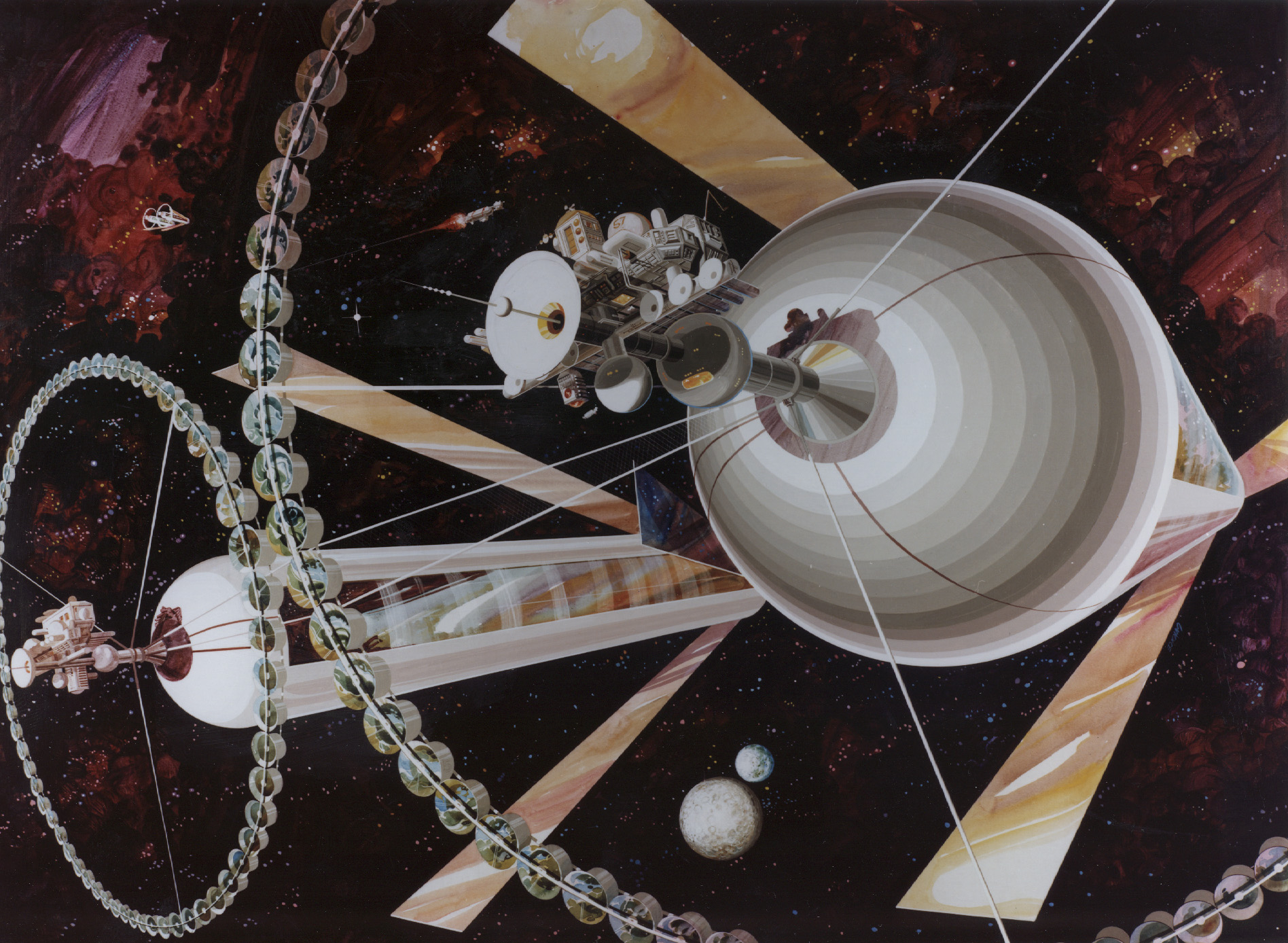
Into Outer Space – SPACESHIPS! And yes, science fiction can be about the exploration of space, colonising worlds, discovering new life and the conflicts that would ensue. What will that mean for us? Would it save us or doom us?
Stories like The Windup Girl, Brave New World, 20.000 Leagues Under the Sea, Red/Green/Blue Mars, Frankenstein, 1984, Dune and Childhood’s End create wondrous and terrifying narratives aimed at questioning and exploring key aspects of changes to our society, if the scenarios play out.
I was born in the late seventies. Back then my family had turn-dial black and white TV with 8 local channels, our telephone was still tethered to the wall and my dad drove an Morris Mini. To visit a friend I had to walk several blocks to knock and ask if he or she wanted to go play, because often they wouldn’t be near the phone. So while I was growing up I dreamed of a future with easier access to knowledge.
Today we literally have access to the world from our smartphone, a device so small it boggles the mind how we made that in my short lifetime, and in the immediate future we’ll be facing personal drones, driverless vehicles, 3D-printing in our garages and personal digital assistants that are more like Tony Stark’s “Jarvis” than Siri. We live in the future and the world is only going to move faster. So the role of science fiction is becoming more and more complicated and fascinating, and has to deal with ethics and morals of technological progress by predicting the potential change and fallout from progress.
Science fiction is an existential metaphor that allows us to tell stories about the human condition. Isaac Asimov once said, “Individual science fiction stories may seem as trivial as ever to the blinded critics and philosophers of today, but the core of science fiction, its essence, has become crucial to our salvation, if we are to be saved at all.
But what do you think of science fiction? Are deeper philosophical musings getting squashed by big shiny tech toys? Let me know and stick around for weekly posts on reading, writing and life in general.


 Torben Jensen
Leave a comment