Your Personal Living Book, The Zibaldone – Or Why Journaling is Good for You.

I have recently been reading The Notebook: A History of Thinking on Paper by Roland Allan. And because of it I have become enamored with the idea of maintaining a zibaldone (Italian for “a heap of things”), which is a combination of a notebook and a journal. A typical zibaldone, if you can claim such a thing exists, would accommodate anything the user found useful: a list of tasks, a text on engineering, use it as day planner, or to build a practical resume, and whatever else the owner treasured. Typically it would contain a wide variety of vernacular texts the writer considered worthwhile enough to write themselves or choose to copy. While most have been lost, those that have survived have given us unique insight into their cultural identity and sense of the world.
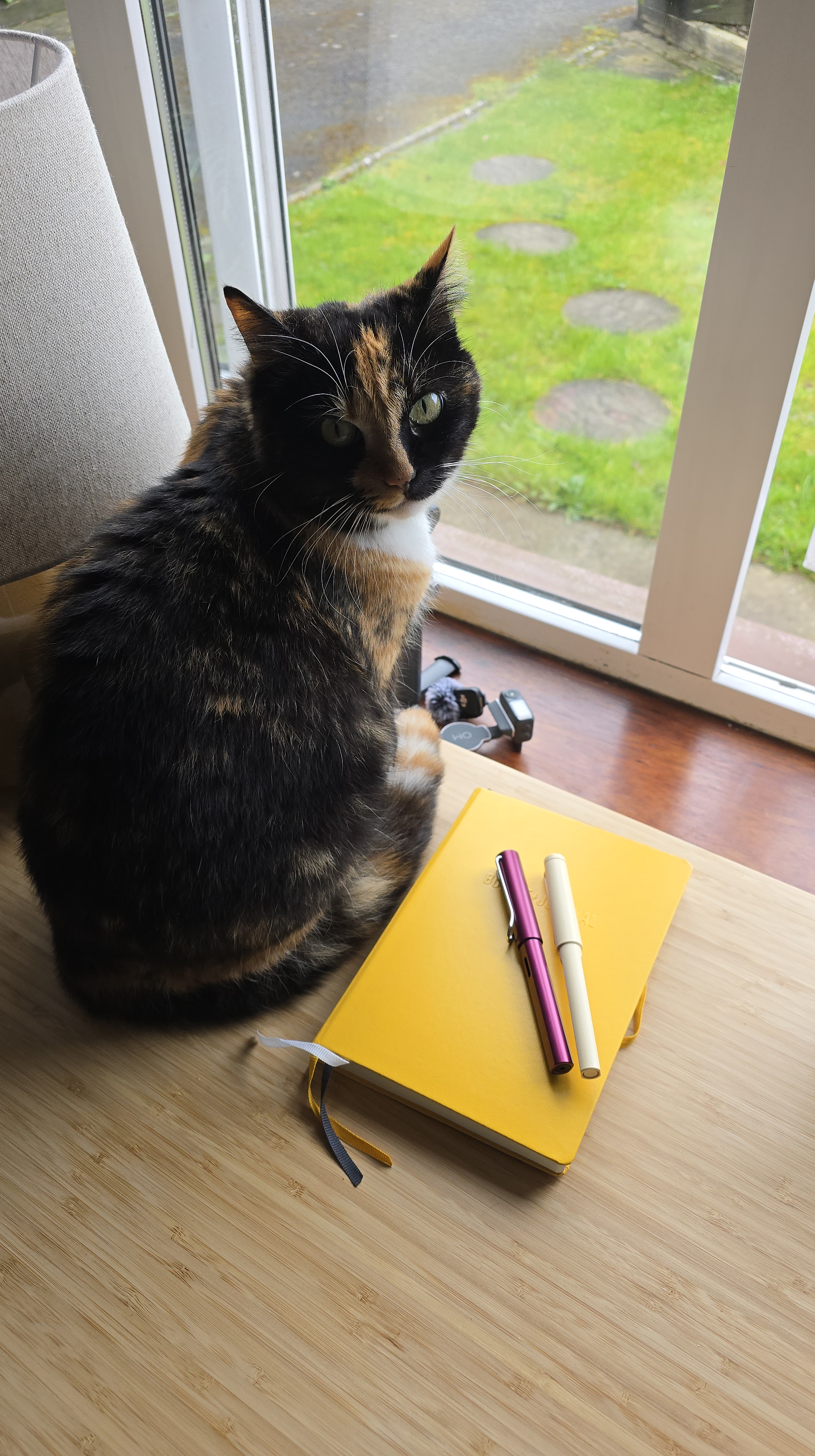
Journal / Zibaldone pictured. Neighbor’s nosy cat for scale.

Historically any material that the owner deemed particularly valuable or beautiful, like poems, bible verses or parts of stories were copied, often verbatim, which is how we have observed the spread and popularity of specific pieces. And while what we know is hardly complete, we have found copies of parts of the Divine Comedy and many religious prayers that were shared widely and we know this because of the large corpus of surviving zibaldoni (plural of zibaldone) that have been examined.

Practical works such as mathematical theorems or navigational observations were copied for their value as knowledge. Even theories about the nature of the universe, or philosophical concepts were found, and of course, the writers would add their own interpretations giving researchers a glimpse into what commoners were thinking at the time. 

This makes a zibaldone a living book, constantly edited, refined and expanded as the need arose. In some cases they became part heirlooms, passed down through generations for decedents to continue working in. It’s fair to argue that the adoption of the zibaldone did the heavy lifting for how we use paper today, from note taking to writing novels to artistry in general, making writing the purview of everyone.

Historically the zibaldone is attributed to Florence as one of the centers of paper making in the thirteenth century, but similar examples can be found throughout the region. n a time where literacy was limited in Europe (approx. 20 percent on average), Florence (and many surrounding parts) sported unheard of literacy rates, closer to 70 percent, largely attributed to a culture of writing and copying texts. In terms of raw popularity the zibaldone is unmatched for the time.

Leonardo da Vinci is likely the most famous and prominent user of zibaldoni maintaining dozens on diverse subjects such as crane designs, observations on water flow, painting with light and the study of horse legs, to mention just a few. A large corpus of these volumes survived until this day. Many of his famous sketches of flying machines or pump designs come from this personal library. Amusingly, he had a penchant for drawing caricatures which appear in many of his zibaldoni, though little is known about the individuals.
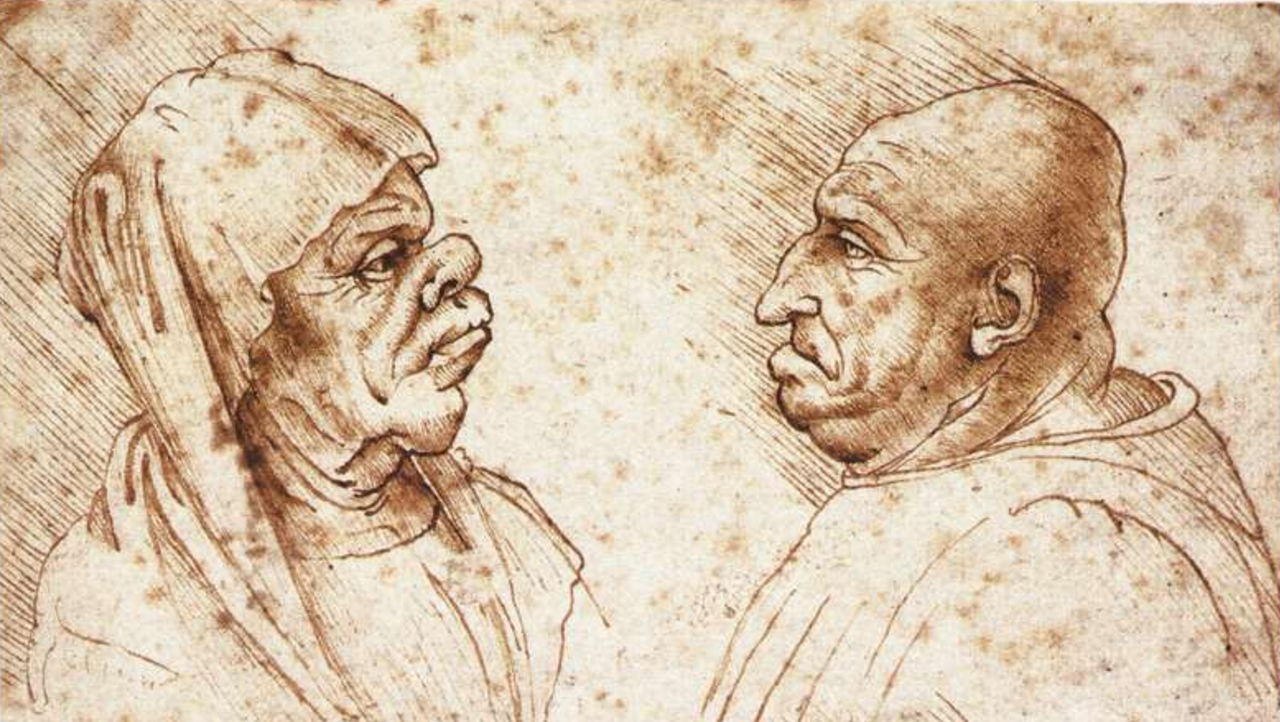
An example of Leonardo’s caricatures.

And while today many have transferred written activities to the digital realm, there are many reasons to keep a paper zibaldone, or journal as my wife insists on calling it. For one, a random solar flare won’t wipe out your property, nor will your content become unavailable if a tech company puts free features behind a paywall or train their AI on your deepest darkest feelings. Or because Cloudflare goes down again. I may sound cynical but the internet undeniably had it’s struggles lately. 

But why should you, a modern day human in the 21st century with access to all the bells and whistles of modern life, maintain a zibaldone? I will give you four reasons:

  • Disconnecting and slowing down

The main point of a zibaldone to me is slowing down and making observations about life, projects and anything in between. Having my morning brew, thinking about where I am going and visualizing how I get there has helped immensely, and also cut down on my doom scrolling significantly.

  • Permanence 

What I write down won’t just disappear, it’s real and tangible and Cloudflare won’t keep me from it. If it wasn’t obvious already, the whole Cloudflare debacle really bothered me. It was a very real showcase of just how much of my digital life is dependent on services and can just… go away without any warning or preamble.

  • Thinking on paper

I had this conversation with many people. What we write down in pen and paper gets processed differently in our brain than things typed into a smartphone. There seems to be a stronger link between writing out the words and formulating the idea on paper, which helps cognition, recognition and improves memory. Doing the same digitally does not have the same effect. So, use it for deeper thinking.

Please note: Bullet Journal offers a membership service, which I don’t use and know little about, but it is an interesting take on the subject if you happen to have one of their journals. 

Bullet Journal is one take of the idea of a living book. Over the years I have accumulated many unused notebooks (because they are pretty and useful and I never had the heart to defile them with my everyday ramblings), so when I found a pretty yellow one, it was naturally added to the collection and sat idle until an idea came along. 

To serve as a starting point, I use the Bullet Journal’s task managing format but tweaked it to my own proclivities. For example, I don’t put everyday to-do lists or shopping in my zibaldone. Instead I use it to track my writing and any other projects and to jot down ideas, big and small. Currently it serves as a writing assistant, for tracking my progress, managing my Beta readers (if you are reading this, you are amazing), taking notes on specific topics or ideas, and organizing tasks. I also have a page for random haiku. My hope is to evolve it over time to include thoughts on life events, deep thinking, and the odd creative piece.

Yes, it’s doodling. And more haiku.

Now, if you want to know about the Bullet Journal system, you can go here for the official version, or here for a more useful overview. 

If you follow me for the book updates, then the first complete draft is slated to finish this month. Thank you for your time. 

Posted a new short over at StoryClub – On Credit

Just a quick update.

Go over to StoryClub to read the short I wrote for their January challenge. Includes several spelling and grammar errors, so feel free to point them out.

The prompt for the story was “Year of the Toad” and had to include the phrases “Ice”, “Dragon” and “Malware”.

You can find it here.

Enjoy!

Leave a comment

Writing Update and Well, I didn’t see that coming

I have been trying to find motivation for this update, so if you only care about the book, then let’s get that out of the way. I got 12 pages of notes to implement ranging from “Add a dog to the sheep scene” to “Research mining related riots in 1929 Scotland“, and the book has remained at 65.000 words.

This is overshadowed by the news that I got made redundant. Not fired without pay, so not the worst way to lose your job, but not ideal at Christmas. This happened a little over two weeks ago and it definitely took the wind out of my sails.

Six years on and the recruitment business is having the financial sniffles, and the only way to survive is to burn out the fever, taking some talent with it. So I guess this is as good a time as any to reassess and reorient, get some rest in and fix the odd bit around the house.

The question that naturally arises is what to do next?

As a child I only had a few things I wanted to be: helicopter pilot, secret agent, and an author. Helicopter pilot was never going to happen due to bad eyesight. Secret agent was the work of silly movies with silly plots and, most importantly, is nothing like real espionage. Which leaves authorship the only viable dream.

My ongoing love affair with books started young for me. I spent more time at the library than in my room as a teenager, and to this day I remember where my favorite sections were at my local library. I remember rows of index cards showing where the good stuff was (Ninjutsu*, Greek myths and African Fauna comes to mind), and exploring shelves for hours just in case I missed something good (which I did. I didn’t read The Lord of the Rings until I was in my early twenties).

As I grew older, the idea of writing a book was something you had to do. In my head, anyone and everyone needed to write a book about something, anything, and add it to humanity’s corpus of knowledge. It’s silly, simple even, but it’s what I expected others would do and I would do the same. The great thinkers of our time had done so, why wouldn’t others try it as well?

Interest in writing and whether you had something to say, didn’t really factor into my logic at the time. Nor did the idea of publishing, building a plot, understanding sentence structure, format, intent or anything else. You just had to contribute. It was the most natural idea in the world, and while over the years I learned that very few people actually think the same way, the realization didn’t temper my drive.

This is the main reason I write. I may never get published and that’s fine, but I set myself the goal of finishing my book in 2026 and this unintentional career break will be a much needed space to get it done.

As this is the last post of 2025, I wish you all a joyful 2026. Happy New Year!

TL;DR – Book is going well, lost my job and I am looking forward to writing more.

  • Autocorrect does not like the word Ninjutsu word. While writing it suggested Ninjitsu, Jujitsu and Injurious as correct terms. Never trust your AI tools.

Posted a new short over at StoryClub – Exposé

Just a quick update.

Go over to StoryClub to read the short I wrote for their November challenge. Includes several spelling and grammar errors, so feel free to go point them out.

The prompt for the story was “Under the radar” and had to include the phrases “Tuna Sandwich”, “Newspaper” and “Lakeside rendezvous”.

You can find it here.

Enjoy!

Leave a comment

Writing Update and Hazardous Words – 18/11/2025

The book has now passed 65.000 words, despite culling over 8.000 words worth of fluff, guff and unnecessary shenanigans. Unfortunately, I won’t be able to work much on it over the next month or two as we are in the middle of moving, and the new place is in need of a loving hand and the occasional use of a sledgehammer. Very exciting.

Hope to have an update around Christmas when things are less chaotic and I can resume work.

That said, I just came back from a research trip in Edinburgh. If I had known a research trip would be that fruitful, I would have made up an excuse to go much sooner. There were a few objectives, but the most important was to visit key locations from the book in and around Edinburgh and get a feel for their physical context, and how their geography would affect the narrative.

Now, I’ve been to Edinburgh before (and I quite recommend it) but those excursions were for other, alcohol fueled, reasons. On this trip I got to examine the city from the viewpoint of someone building a narrative and it changes how you experience the city. It ceases to be a series of individual buildings or sites, and becomes a massive group of interconnected systems; roads and sewer connections inform how the city operates, smells and functions, parks become scenes instead of just scenery, and institutions become places of power and influence. Your characters start roaming the streets and the streets influence what they can do, both limiting in scope and expanding in opportunity.

The trip was simultaneously disheartening and invigorating. Disheartening that the real life locations for some scenes are simply not suitable, and invigorating that I could find alternatives sometimes just a few hundred meters down the road.

For example, I initially wanted to place a fictional bookshop at Arthur Conan Doyle’s place of birth, here if you are interested. What I envisioned was a lone edifice holding out against the encroaching dark, both literally and metaphorically, but after reviewing maps from the time period and visiting the location it became evident that it didn’t work. Feeling dejected, my wife and I wandered the neighborhood looking for an alternative, and while searching for a caffeinated beverage, found it. Just around the corner were several smaller, Georgian style buildings that would fit the imagined book shop, including smaller cobbled passageways for those illicit activities or escape routes.

It may sound silly, but grounding the story in a real location with real limitations feels like the correct approach. And this is just one example of many. We wandered about the old buildings of Edinburgh University, toured cathedrals and went strolling around the park near Blackford Hill. The Scottish Mining Museum was also a great experience.

Geography is especially important to me. It’s a pet peeve of mine when liberties are taken with facts. If locals can call out on something because it didn’t exist as portrayed, such as a location or a distance central to the story, the book isn’t accurate enough. Unless explicitly excused (read: alternate timeline, genius inventor or similar), I simply prefer it to reflect reality.

Personally I enjoy writing around limitations, it tends to improve the reading experience. This extends to technology, use of historical characters, and so on. Taking liberties is fine, in context, but personally I try to stick to reality as much as possible. It grounds what could otherwise become a flight of fancy.

And interestingly, it turns out some of my choices in geography were dead on, so kudos to me, and the very lovely people at the Scottish Mining Museum and Edinburgh University who dedicated their free time, hospitality and were patient and helpful with my very specific queries.


Anyway, I wanted to get this post out before I shatter my spine carrying moving boxes. Here are a few tips I have been thinking about recently to help you tighten up your own writing.

Weasel words – “Maybe we could do something new.”

Anyone with an academic background probably had a conversation about weasel words. These are words that dilute your argument or commitment and that reduces the value of what you’re saying. Unless your aim is to dilute your statement or create a feeling of indecision, consider purging it from your writing. Make it something you consciously choose to use.

Filter words“Jerry sensed (or thought or understood or spotted) the weather changing.”

Or maybe the weather changed. Similarly to ‘Weasel’ words, ‘Filter’ words are used to mediate or interpret a situation through the character, instead of giving the reader a visceral impression. Its the difference between seeing a recording, or witnessing it in-person.

This article explains it quite well.

TL;DR – Book is going well. Be careful with weasel words and make an active choice to use filter words in your writing.

Leave a comment

Posted a new short story over at StoryClub – Strike Out

Just a quick update.

Go over to StoryClub to read the short story I wrote for their September challenge.

The prompt for the story was “Lapsed” and had to include the phrases “Handsome man”, “Pleasing aroma” and “Bowling ball”.

You can find it here.

Enjoy!

Leave a comment

Writing Update and Musings on Scope – 02/07/2025

To get the progress report out of the way.

As I am finishing this post, the word count is just shy of 53.000, which I am quite happy with. My initial goal for the book was at least 50.000 words, but that was by no means the end point. Especially not now that the scope has expanded, which is what I wanted to write about today.

First off, I would encourage any would-be writer to path out your narrative ahead of time. I spent a few hours plotting out my characters and created an Excel sheet to see just how good (or bad) my outline is. As it turns out, it was too simple. Or rather, there was a story and an arc for the main character, but there was little mystery, background and worldbuilding, only ideas here and there.

So I took a break from writing and listened to a few books for inspiration, specifically Rivers of London and Moon over Soho by Ben Aaronovitch (delightful reads and exceptionally well narrated by Kobna Holdbrook-Smith). I could gush over them for hours and I just might at some point, in audio <— Foreshadowing.


Like many others have said: the best way to become a better writer is to write. What helps immensely though is reading extensively as well. I love the writing and the performance of Rivers of London, so I wrote down, and tried to codify what is was that made the story come alive to me. None of the following realizations are revolutionary, but they pushed me forward and expanded the scope of my own project, so maybe it can help you.

The Need to Paint the scene… in a physical sense and, more importantly, what it feels like to be there. If you read the book, Peter (the main character) comments on everything around him through dialog with others and his own internal narration. He comments on the little things, what does or doesn’t remind him of home, how the lives of others changes how he views a scene? Whether something is a tired old hat, or new, or dangerous, or just background noise adds layers that texture the scene.

You get a closer, more intimate narrative that adds subtle texture to a story. It’s the difference between knowing there is a Circle line on the London Tube and telling the reader or explaining what it feels like to be sat boiling in the July heat en route from Paddington to Edgware Road Station. One is factual, the other experiential.

There is a part in Rivers of London where magic, something wildly exotic, is observed by the main character with near boredom. Taking you, the reader, into the mind of Peter and showing how he sees the world and his progression as a character, without over-explaining it through the events.

Reflecting on What Happened – The reader of a book has the privilege of consuming a series of curated events and experiences that tie together and create the plot. The characters in the book don’t know that, so you need to show how the character reflects on what is happening. In the moment, ten pages later, a hundred pages later, the way characters visit and revisits events showcases how they perceive the evolution of their own story and understand their place in it. Or in many cases, don’t understand it. Not the chain of events, but the causal links in a chain and how they interconnect.

If the character doesn’t understand where they come from and how they got to a certain place, the reader won’t be invested either. Exploring their hopefully growing understanding of what is happening in the story or lack thereof, the reader gets to understand them better.

Personally, I have a problem with rooting for two-dimensional characters that have no understanding, lack motivation or a goal. We need to see them engage with the plot, not adrift in it.

Having Opinionated Characters – Opinions are like assholes, everyone has them. So have characters that share their opinions to showcase how those opinions change over time. The experience of an event, banal or fantastic, good or bad, seen by someone in situ again adds more texture, more micro narrative to your story.

These can be small details like the taste of a cocktail, a preference for jazz music, or someone’s perceived reputation (truthful or not) or larger events, like the death of a character, the swing of public opinion or breaking a taboo; the latter is especially interesting when you have characters that are strongly invested in upholding that taboo.

Cross-cultural understanding is interesting, but cross cultural conflict between characters, factions, neighbors, parents, dogs, cats, whatever you have is so much more engaging.

I find that Aaronovitch is fantastic at weaving in the feel of a culture, how the characters understand their place in it and how they represent it through their built-in biases, ideas, hopes and dreams, by getting the cast to externalize what they see things, what they do and don’t know.

These initial takeaways helped to expand the scope of my book, hopefully in good way.


However, I have a problem managing scope. This is a common issue for me and as this is project will eventually need to end. It’s an issue if I keep adding ideas that pop into my head. I refer to it as Concept Creep and it has become the one thing I am desperately trying to curb before it overwhelms me.

Back when I wrote my theses, my first meeting with a lecturer on what the scope of the piece would be, the lecturer bemusedly informed me that what I thought was a decent, well defined, idea would take at least a Phd level project to explore fully. Two would be better. So this is nothing new.

For that reason, if you have similar issues with your writing, get your basics done first. Figure out the plot, subplots, the main themes, events and characters. If you have a lot of lore, keep a lore bible. It can be a notebook, some digital log or worldbuilding app. Once you have the basics figured out, you can focus on texturing the piece. Smaller backstories that get peppered in to flesh out characters, a comment here, a plot device there that pays off in the finale. And don’t be afraid to cut out segments that aren’t working.

My first 17.000 word draft included a very complex backstory and specific events for a character that wasn’t needed. For now, that piece is relegated to the lore bible, but once the book is finished it might get pulled back in, or even reused in another work. We will see.

TL:DR – If you are stuck in your own writing, go read something, take notes, compare it to your own writing and see if you can take inspiration from it.

Have a great summer!

Leave a comment

Writing Update and why Window key + H is amazing – 11/05/2025

You only need to break two metacarpals to get wildly sidetracked from writing and other creative pursuits which is why I haven’t updated the website in a while. That and I am in the process of buying a house, which is going well, but all in all it has taken away time and energy. But mostly its the hand.

And while in the grand scheme of things its not a major injury, it has been debilitating. The short version of what happened; it turns out security doors are harder that my bones. Especially if one slams on your hand when you aren’t looking. I was not amused.

Please enjoy this x-ray and the associated distress.

What has this experience taught me?

Life will happen, accidents will happen, and you will have to adapt.

For work and for my personal writing I had to change, amend, or outright write off deadlines and goals that were unattainable. This sucked the motivation right out. I had finally established a strong writing routine, consistently producing around 500+ words daily, and over night it was gone. So I adapted and found new tools to help me.

It is inevitable, that something like it will happen to you, so take it as an opportunity to reorient yourself and try different ways of doing things. For me, I settled into a routine of reviewing, revising and working on the world building for the novel. That latter one is just reading a lot. I recommend it.

The other thing I discovered that allowed me to continue working professionally and on my writing was the speech-to-text option in Windows 11. It is an accessibility that allows you to dictate directly through your device microphone and the tool will transcribe it word for word.

Use the Window key + H to access the tool. Read more here.

My personal use case is for email and light writing, but like most things its not perfect.

Its awkward to use

To be clear, this is not like using Alexa or Siri. You are essentially talking to yourself and there is no fancy filter to fix your mishaps. In the beginning it will feel weird. You will mumble, stutter, say the wrong word, etc. but once you get used to it, it will be fine.

Consider what you want to write first, then speak slowly and clearly, enunciating every word fully. Don’t be alarmed if what is appearing on the screen is incorrect. Finish it first, then fix any mistakes.

You need editing

While impressive, its not perfect. If you’re not a native speaker, or have a tendency to mumble, or even speak too fast, it will have trouble recognizing what you say. Grammar is also finicky, but you can disable automatic-punctuation depending on your preference.

Just get the basics down and edit it.

It wont work public

Ignoring the social aspects of speaking to yourself in public, the tool doesn’t work well in noisy environments. As of writing this, its not capable of separating out your voice pattern from others.

At work I had the pleasure of accidentally transcribing most of what my colleagues said, which was hilarious to read, but made it unusable.

And lastly, a quick aside on the novel.

As of right now, I am back to my writing schedule, which remains the same 250 new words every day until the first draft is done. Right now, the novel has hit 47.700 words, which is about 2/3 of the way towards my end goal. I hope to have the first draft finished by the end of summer, so stay tuned if you want to keep up.

Stay safe and don’t break anything!

Leave a comment